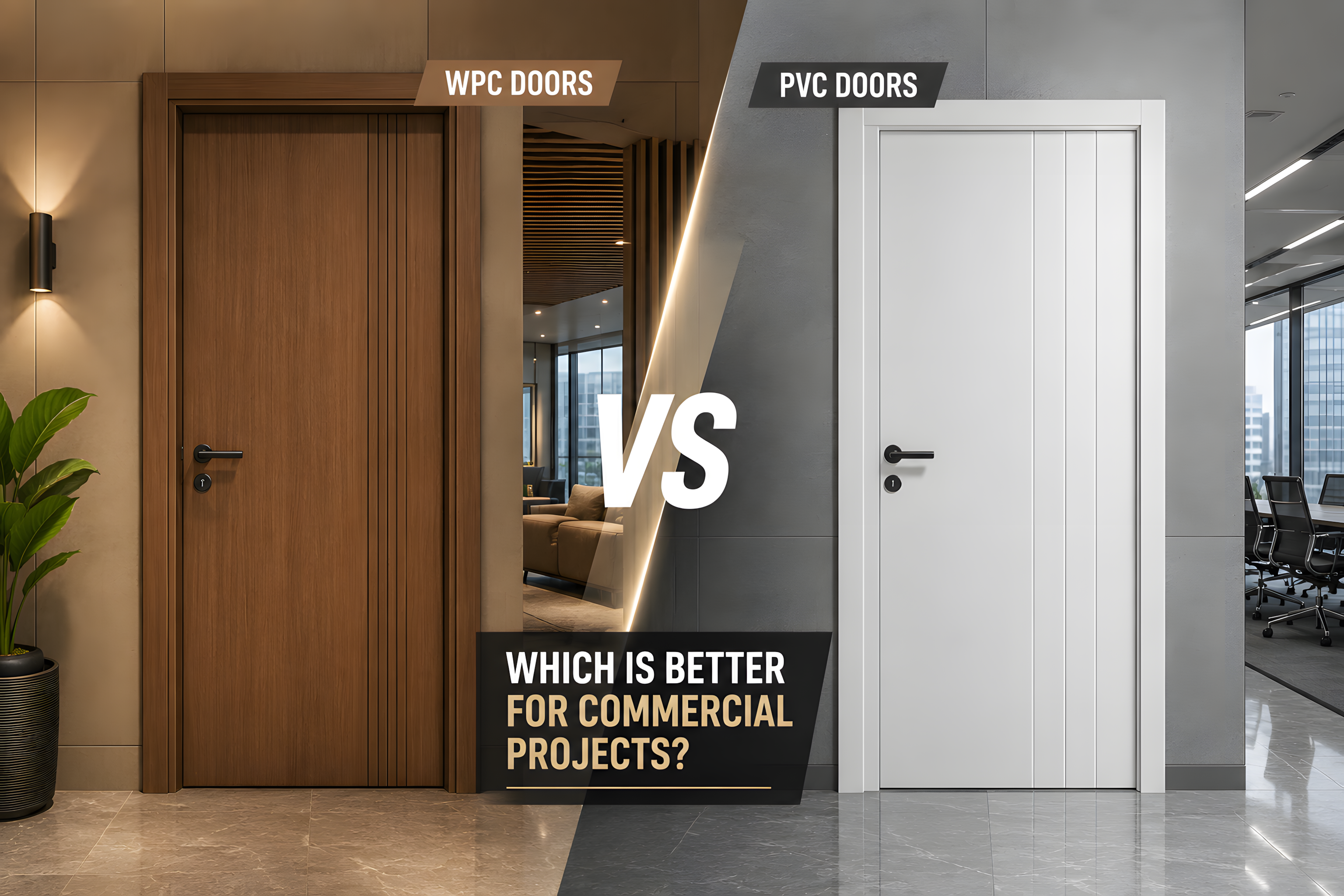
Picture two identical commercial buildings going up across the street from each other. Same budget, same timeline, same contractor crew. One developer specs PVC doors throughout. The other goes with WPC. Eighteen months later, one building's doors still look brand new. The other's are starting to bow at the bottom edge from moisture exposure in the restrooms.
This isn't a hypothetical scare story — it's a pattern procurement teams see often enough that "WPC vs PVC" has become one of the most common questions in commercial door sourcing. Both materials look similar on a spec sheet. Both are marketed as moisture-resistant, low-maintenance alternatives to wood. But they are not the same product, and for high-traffic commercial environments, the difference shows up faster than most buyers expect.
This guide breaks down what actually separates the two — structurally, financially, and in real-world performance — so you can make the call with your eyes open instead of guessing based on price per unit.
First, What Are We Actually Comparing?
PVC doors are made from rigid polyvinyl chloride — essentially a solid or foamed plastic door, sometimes reinforced internally with a frame for structural rigidity. They're lightweight, fully synthetic, and have been a staple in budget commercial and residential builds for decades.
WPC doors (Wood Plastic Composite) blend wood fiber or calcium powder with PVC or PP resin, fused under heat and pressure. The result behaves more like engineered wood than plastic — heavier, denser, and closer in feel and finish to a traditional timber door.
The short version: PVC is plastic pretending to be a door. WPC is a door that happens to use plastic. That distinction matters more than it sounds.
Durability: Where the Real Difference Shows Up
On paper, both materials resist moisture and pests. In practice, they age very differently under daily commercial use.
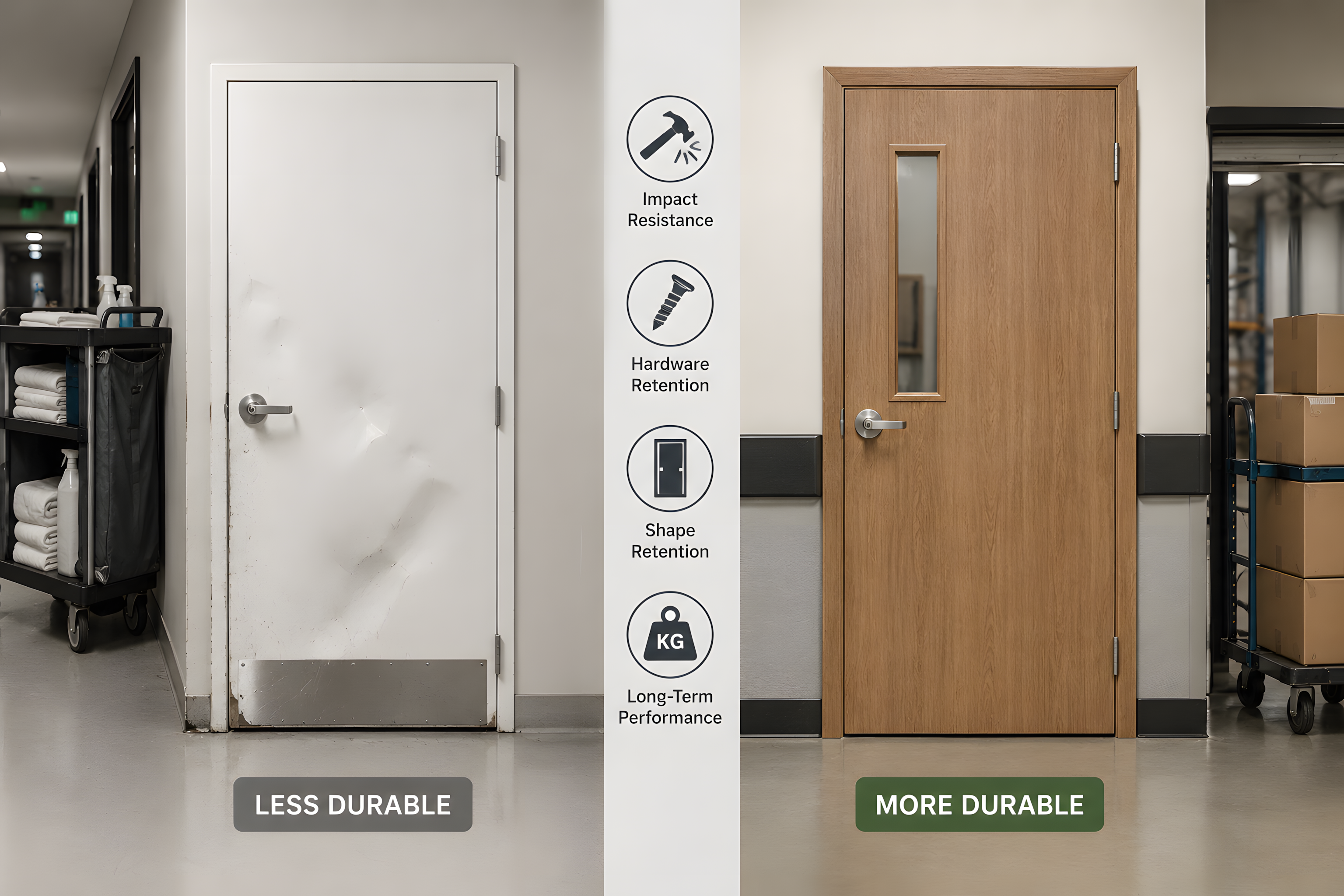
PVC doors are prone to flexing and impact denting, especially in high-traffic areas — think hotel housekeeping carts, retail stockroom doors, or busy hospital corridors. Because the core is often hollow or lightly reinforced, repeated impact can cause visible deformation over a few years.
WPC doors carry significantly more density and structural rigidity. The composite core resists denting, holds screws and hardware more securely over time, and tends to maintain its shape even under sustained mechanical stress — closing slams, cart impacts, heavy hardware loads.
If your project involves doors that will be opened and closed hundreds of times a day, this single factor often decides the comparison before you even get to price.
Moisture, Climate, and the Humidity Test
This is the category both materials genuinely compete in — and both perform well compared to solid wood. But "well" isn't "identical."
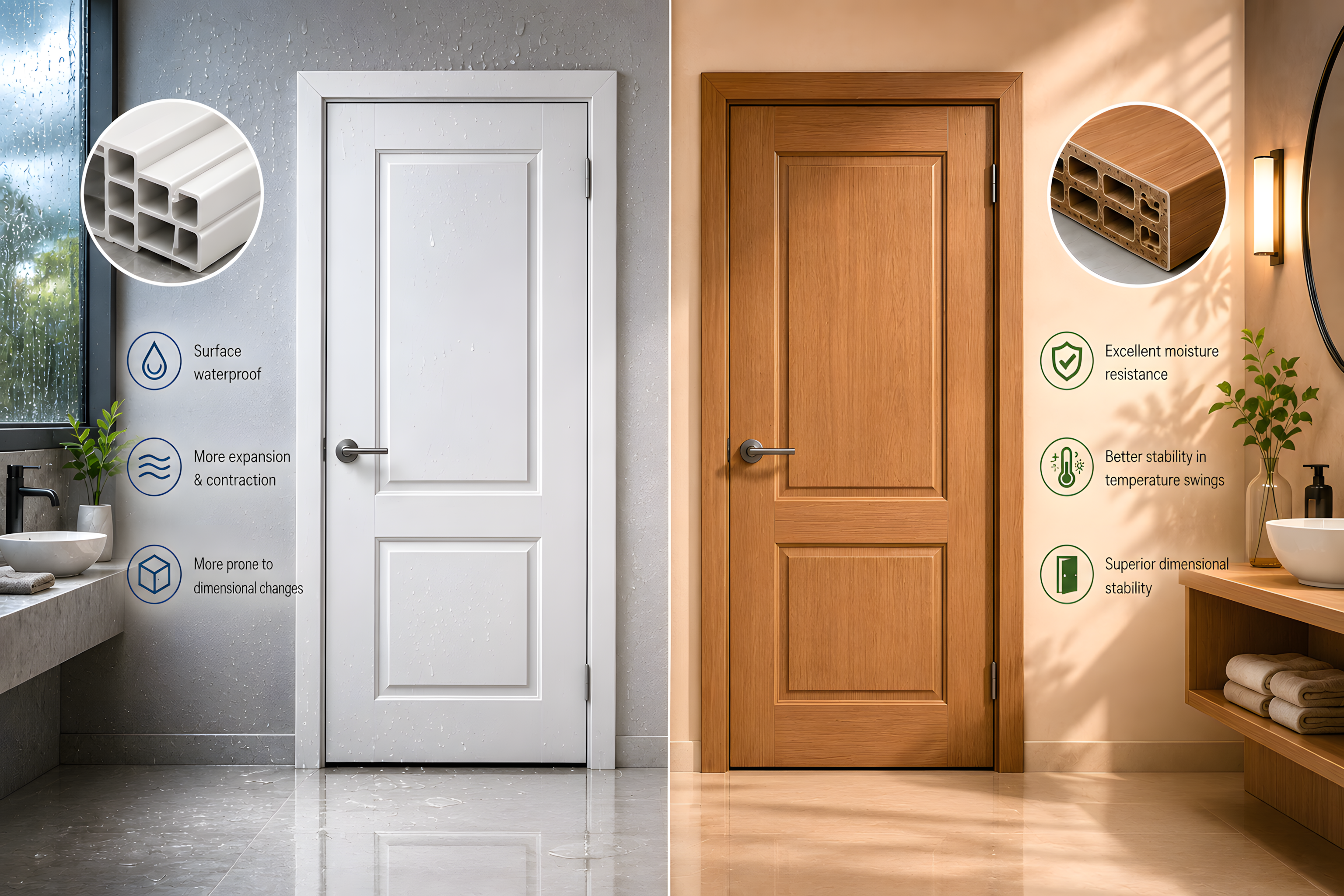
PVC doors are essentially waterproof at the surface level, since the material itself doesn't absorb water. However, hollow-core PVC doors can trap condensation internally in fluctuating humidity environments, leading to a hollow, less solid feel over time and occasional internal moisture buildup.
WPC doors resist surface moisture extremely well and, because of their denser core, don't suffer from the same internal condensation issue. They also tend to handle temperature swings — hot days, air-conditioned interiors — with less expansion and contraction than PVC, which can soften slightly in high heat.
For coastal properties, tropical climates, or buildings with inconsistent HVAC, WPC generally holds its dimensional stability better across seasons.
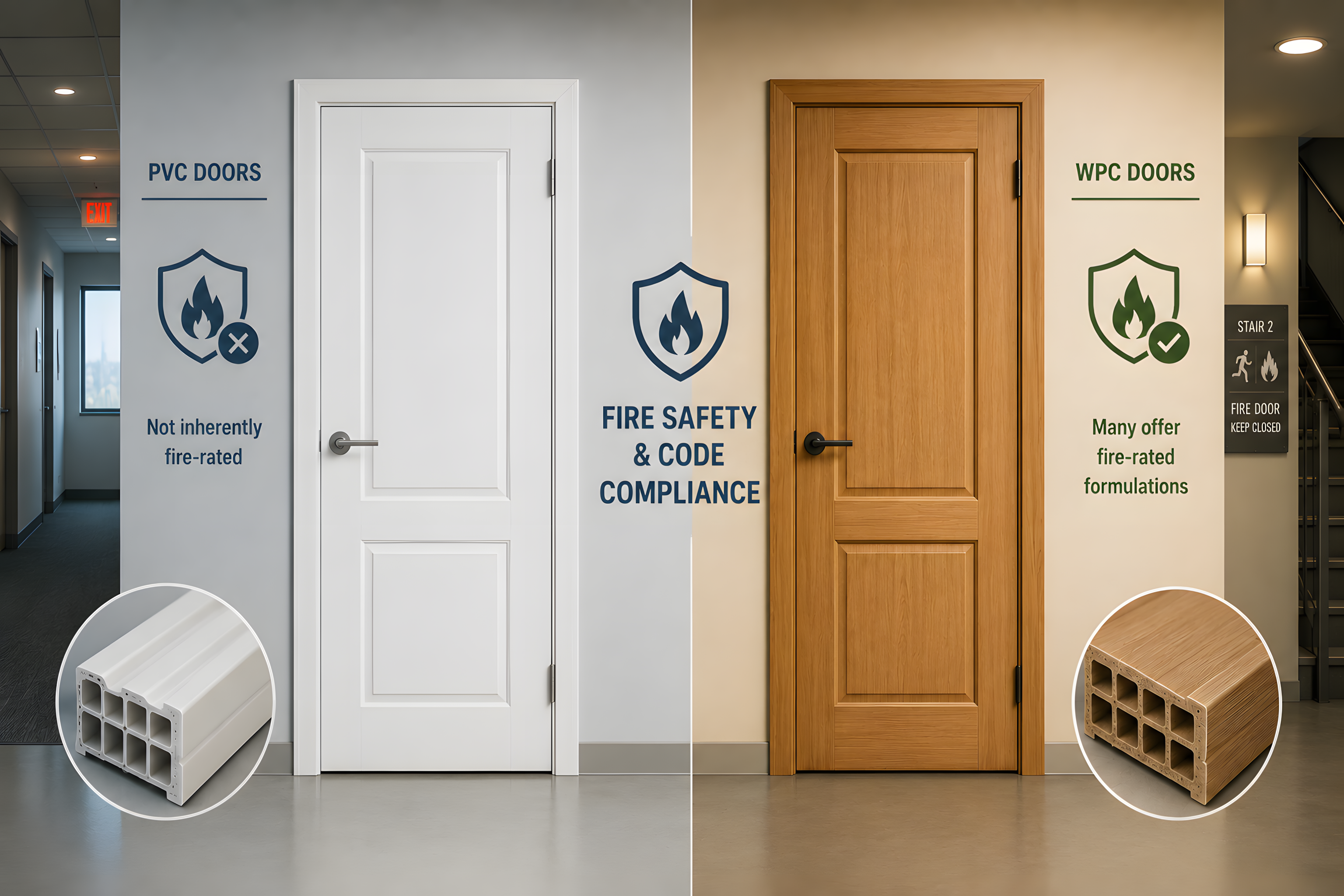
Fire Safety and Code Compliance
Commercial buildings — hotels, offices, healthcare facilities — almost always have fire-rating requirements for corridor, stairwell, and unit-entry doors. This is an area where the two materials can diverge significantly depending on manufacturer and formulation.
Standard PVC doors are not inherently fire-rated and often require additional core reinforcement or are excluded entirely from corridor and stairwell applications in many commercial codes.
Many WPC door manufacturers offer fire-rated formulations specifically engineered for commercial compliance, since the denser composite core supports better fire-resistance ratings than hollow or foamed PVC.
If your project includes any fire-rated door requirements — and most multi-unit commercial buildings do — this isn't a minor detail. Confirm certification with your supplier before specifying either material for those locations.
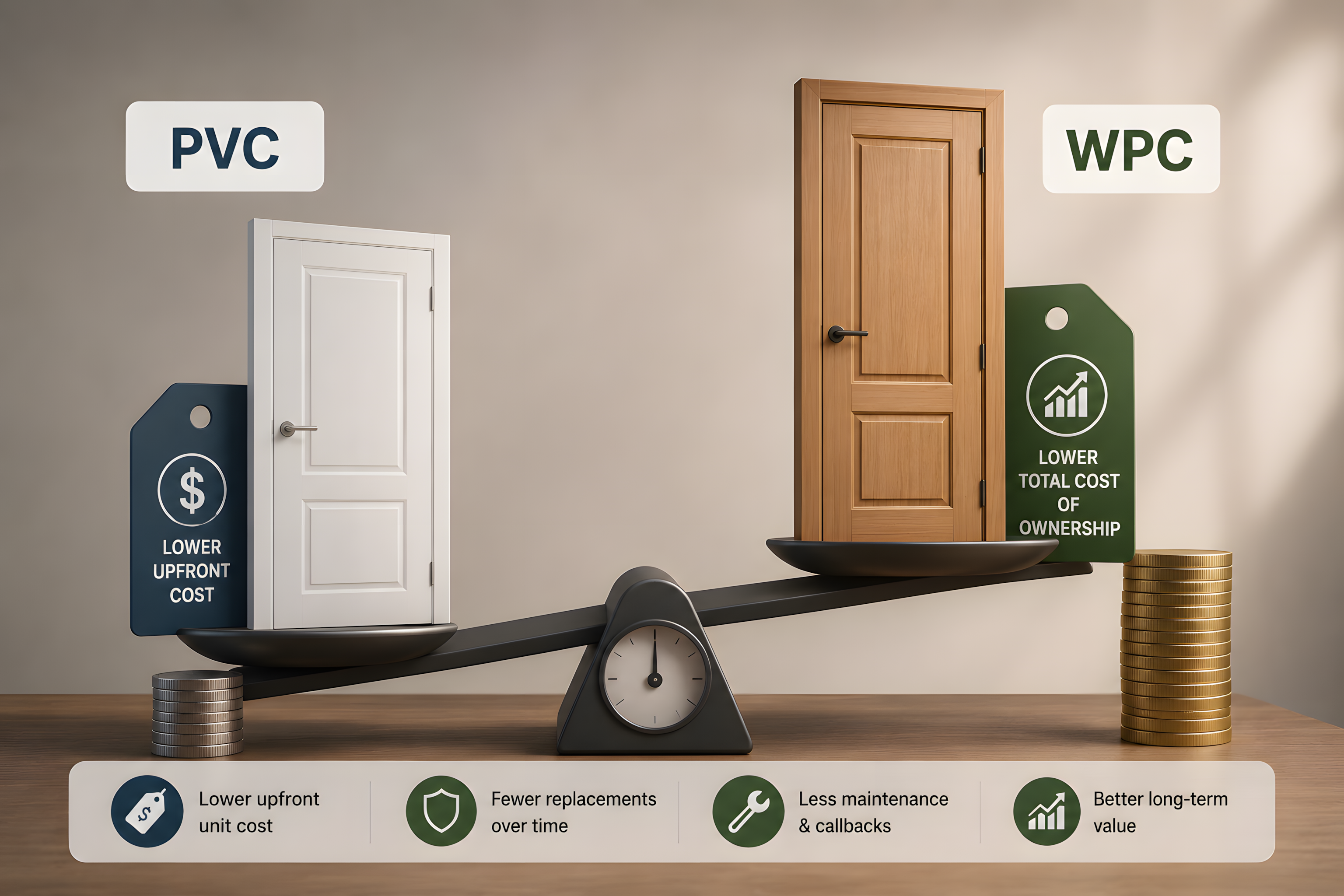
Cost: Upfront Price vs. What You'll Actually Spend
This is where the conversation usually starts, and where it's most often oversimplified.
PVC doors typically have a lower upfront unit cost, which makes them attractive for large-volume projects with tight initial budgets — think mass residential developments or low-traffic interior doors where durability demands are lower.
WPC doors usually carry a moderate premium over PVC, but the lifecycle math tells a different story for commercial use: lower replacement frequency, less warping-related callback work, and better resale or asset value retention for the building owner.
For a quick framing: PVC often wins on acquisition cost. WPC usually wins on total cost of ownership — particularly in high-traffic or high-humidity commercial settings where doors take real abuse over a 10+ year building lifecycle.
Side-by-Side Comparison
| Factor | PVC Doors | WPC Doors |
|---|---|---|
| Weight & Density | Lightweight, often hollow-core. | Heavier, dense composite core. |
| Impact Resistance | Prone to denting under heavy use. | High resistance to denting and warping. |
| Moisture Performance | Surface-resistant; internal condensation risk. | Strong moisture resistance throughout the core. |
| Fire Rating Availability | Limited; often requires reinforcement. | Commonly available in fire-rated formulations. |
| Upfront Cost | Lower. | Moderate. |
| Lifecycle Cost | Higher due to replacement and repair costs. | Lower due to reduced maintenance and longer lifespan. |
| Aesthetic Feel | Plastic look and feel. | Closer to natural wood appearance. |
| Best Suited For | Low-traffic interior doors and budget-focused projects. | Commercial, hospitality, healthcare, and high-traffic environments. |
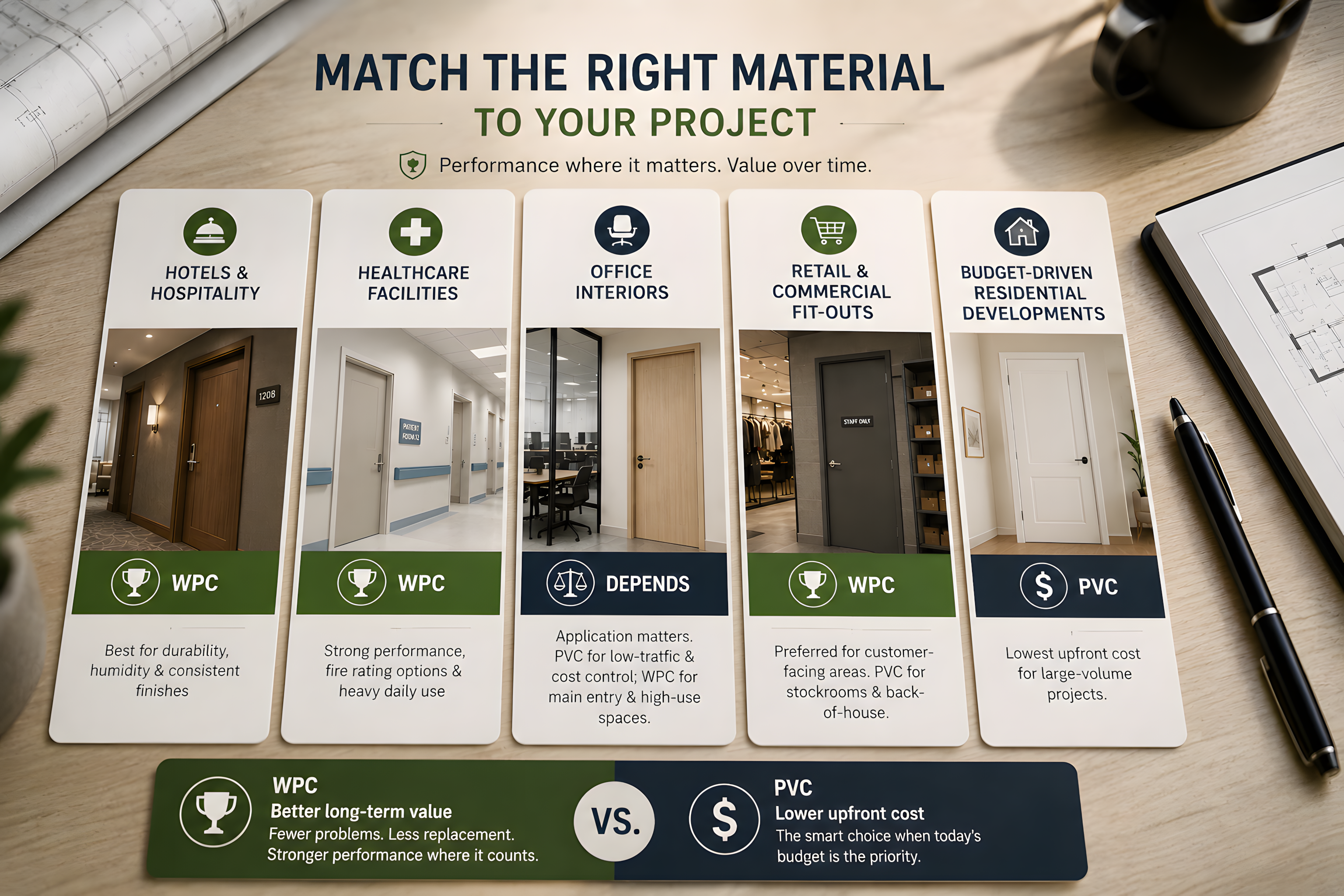
Which One Wins for Your Project Type?
Rather than declaring an overall "winner," it's more useful to match the material to the project's performance requirements.
Hotels and hospitality — WPC is generally the stronger choice. High traffic, bathroom humidity, and the need for consistent finishes all favor WPC's durability, stability, and design flexibility.
Healthcare facilities — WPC again tends to have the advantage, particularly where fire-rated options, frequent cleaning, and heavy daily use are important considerations.
Office interiors — This category depends on the application. PVC can be suitable for low-traffic partition doors where cost control is a priority. For main entrances, meeting rooms, and heavily used spaces, WPC's durability often provides better long-term value.
Retail and commercial fit-outs — Both materials can work, but WPC is often preferred for customer-facing areas where appearance, longevity, and resistance to wear matter most. PVC may remain a practical option for stockrooms and back-of-house spaces.
Budget-driven residential developments — PVC continues to be a cost-effective choice for large-volume projects focused on minimizing upfront investment. However, where long-term performance and reduced replacement needs are priorities, WPC can justify its higher initial cost.
For most commercial environments, WPC offers the broader performance envelope, while PVC remains a viable solution in applications where initial budget is the primary decision factor.

Frequently Asked Questions
### Is WPC always more expensive than PVC? Not always — pricing depends on formulation, finish, and supplier, but WPC typically carries a moderate premium over standard PVC. The gap often narrows or reverses when factoring in lifecycle and maintenance costs.
### Can PVC doors be used in fire-rated applications? Standard PVC doors generally aren't fire-rated without additional reinforcement. If your project requires fire-rated doors, confirm certification directly with your supplier rather than assuming compliance.
### Which material looks more like real wood? WPC doors generally offer a closer visual and tactile match to natural wood, since the composite core supports more realistic veneer, laminate, and grain-textured finishes.
### Do WPC doors require more maintenance than PVC? No — WPC doors typically require less maintenance over time, since they resist denting, warping, and internal moisture issues better than PVC, reducing the need for repairs or replacement.
### Is one material more sustainable than the other? WPC doors often use recycled wood fiber or calcium powder as part of the composite, which can make them a more resource-efficient option compared to fully virgin PVC, depending on the manufacturer's sourcing.
The Real Question Isn't Which Material Is Better — It's Which Fits Your Project
WPC and PVC doors aren't really competing for the same job. PVC earns its place in budget-conscious, low-traffic applications where upfront cost drives the decision. WPC earns its place wherever a door needs to survive years of real commercial abuse — heat, humidity, heavy use, and the wear that comes with hundreds of people passing through every day.
The smartest procurement decisions aren't about picking a "better" material in the abstract. They're about matching the right material to the right door, project by project — and working with a supplier who can back up their claims with real certifications, not just a sales sheet.